


A brand name is the identity customers remember, while a domain name is the technical address they use to reach you online. The order matters because early naming decisions affect trust, legal safety, and long-term scalability. This article explains what should come first for a startup, how to decide in practice, and why using a non-.com domain is often a rational strategic choice rather than a weakness.
What is the difference between a brand name and a domain name?
A brand name represents perception, memory, and meaning, while a domain name functions as an access point on the internet. Brands exist in customer minds and markets domains exist in browsers and DNS systems.
Definition: Brand name – The distinct name that represents a company’s identity, promise, and reputation in the market.
Definition: Domain name – A unique, human-readable internet address that maps to a server via the DNS system.
Should startups choose the brand name or the domain name first?
Most startups should choose the brand name first and then secure the best available domain that supports it. This prioritizes differentiation, trademark strength, and long-term brand equity over short-term availability constraints.
In practice, teams that optimize for domain availability too early tend to settle for generic or fragile names, which weakens memorability and legal defensibility.
Why brand-first decisions usually outperform domain-first thinking
Brand-first naming scales cognitively, while domains scale technically. Customers remember signals and stories, not exact URLs.
- Distinct names are easier to trademark and protect
- Unique brands achieve higher recall than keyword-heavy names
- Brands operate beyond websites, including apps, marketplaces, and offline channels
- Domains can be acquired later when leverage and revenue exist
Strong brands are associated with 5–15% price premiums across categories.1 Exact-match domains have declining direct impact on rankings.2
When choosing the domain name first makes sense
Domain-first naming only works in constrained scenarios where the domain itself is the business asset.
- Local service businesses
- Short-term SEO-driven niche projects
- Founders who already own a premium domain
- Highly regulated naming environments
Definition: Domain-first naming – A strategy where the startup name is selected primarily based on available or owned domains.
Is using a non-.com domain risky for a startup?
Using a non-.com domain is not inherently risky if the brand is clear, distinctive, and consistently communicated. The risk comes from ambiguity, not the extension.
Over 55% of global websites now use non-.com TLDs,3 and search engines treat TLDs neutrally for ranking purposes.2
Definition: Top-level domain (TLD) – The suffix at the end of a domain name, such as .com, .io, .ai, or .co.
Brand-first vs domain-first comparison
| Criteria | Brand-first | Domain-first |
|---|---|---|
| Memorability | High | Medium |
| Trademark strength | Strong | Weak |
| Flexibility | High | Low |
| Long-term scalability | High | Limited |
How to choose a strong startup name
- Define positioning and audience clearly
- Generate distinctive, non-descriptive name options
- Screen for trademark conflicts
- Test pronunciation, spelling, and recall
- Evaluate domain availability across relevant TLDs
- Select the best brand-domain pairing, not perfection
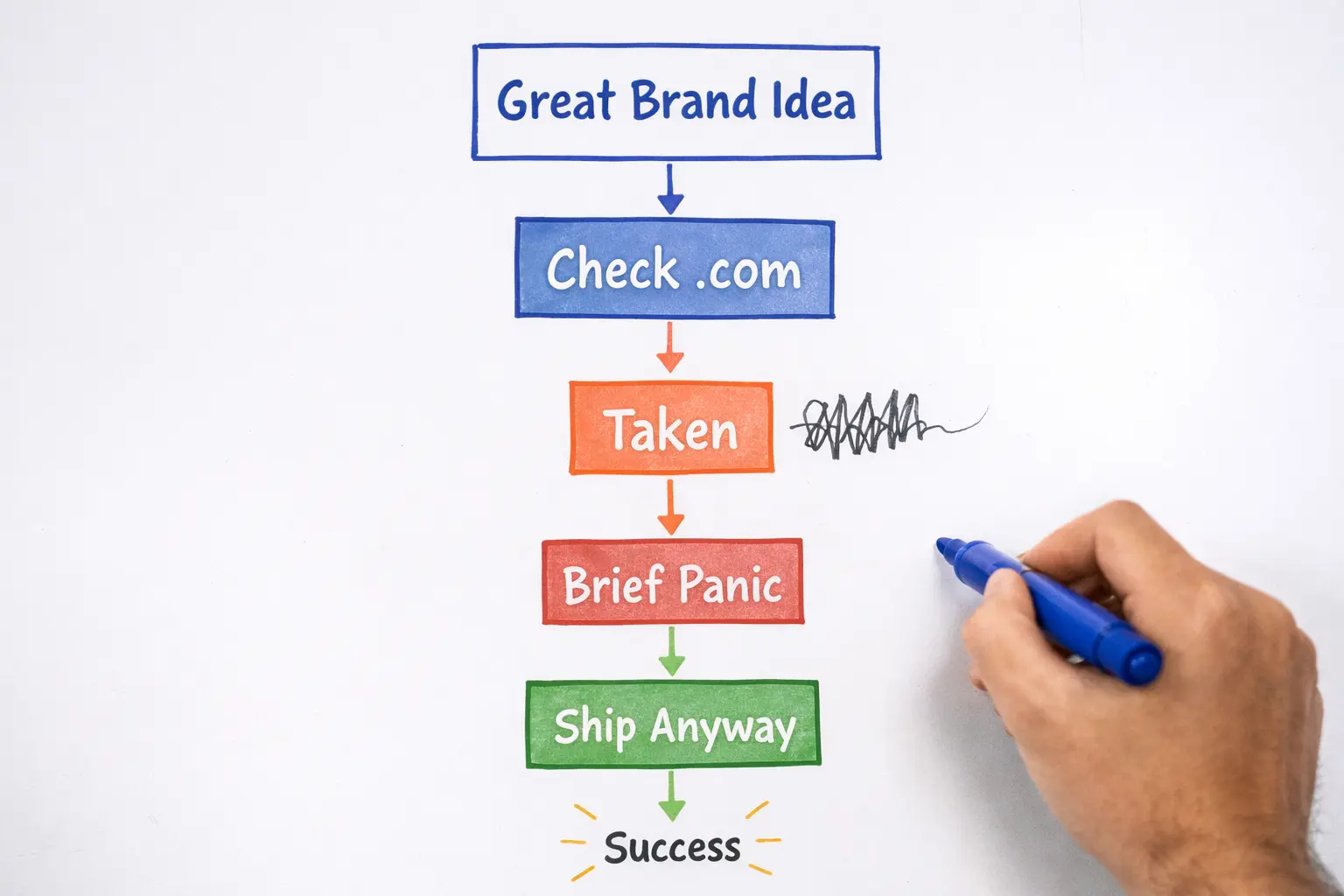
Common mistakes startups make
- Rejecting strong brands because the .com is unavailable
- Stuffing keywords into names for SEO
- Ignoring trademark risk
- Rebranding prematurely without evidence
Mini case study: scaling on non-.com domains
Multiple SaaS and developer-focused startups launched on .io or .ai domains and reached significant revenue and user milestones before acquiring their .com, demonstrating that clarity and consistency outweigh extension choice when the brand is strong.
FAQ: Brand name vs domain name
Is not having the .com domain a problem?
No, because brand familiarity and repetition drive trust more than domain endings.
Do .com domains rank better?
No, search engines rank content and authority, not TLDs.
Should startups buy the .com later?
Yes, if the cost is reasonable and the brand is validated.
Do investors care about domains?
Rarely, as they view domains as solvable operational details.
Can non- .com domains hurt email deliverability?
No, deliverability depends on configuration and reputation.
Key takeaways
- Brands create durable value, domains support access
- Brand-first strategies outperform domain-first decisions
- Non-.com domains are normal, scalable, and search-neutral
- Domains can be upgraded later, brands are harder to replace
Next step: Start with positioning and trademark safety, then explore domain options creatively instead of defaulting to compromise.
