


A startup name is the linguistic wrapper around a business idea, designed to be remembered, searched, and trusted.
It matters because names influence recall, differentiation, and brand perception long before a product is fully understood.
This guide explains why many successful startup names initially sound strange, how that weirdness becomes an advantage, and how to generate strong, brandable names using modern AI tools like Domain Generator.
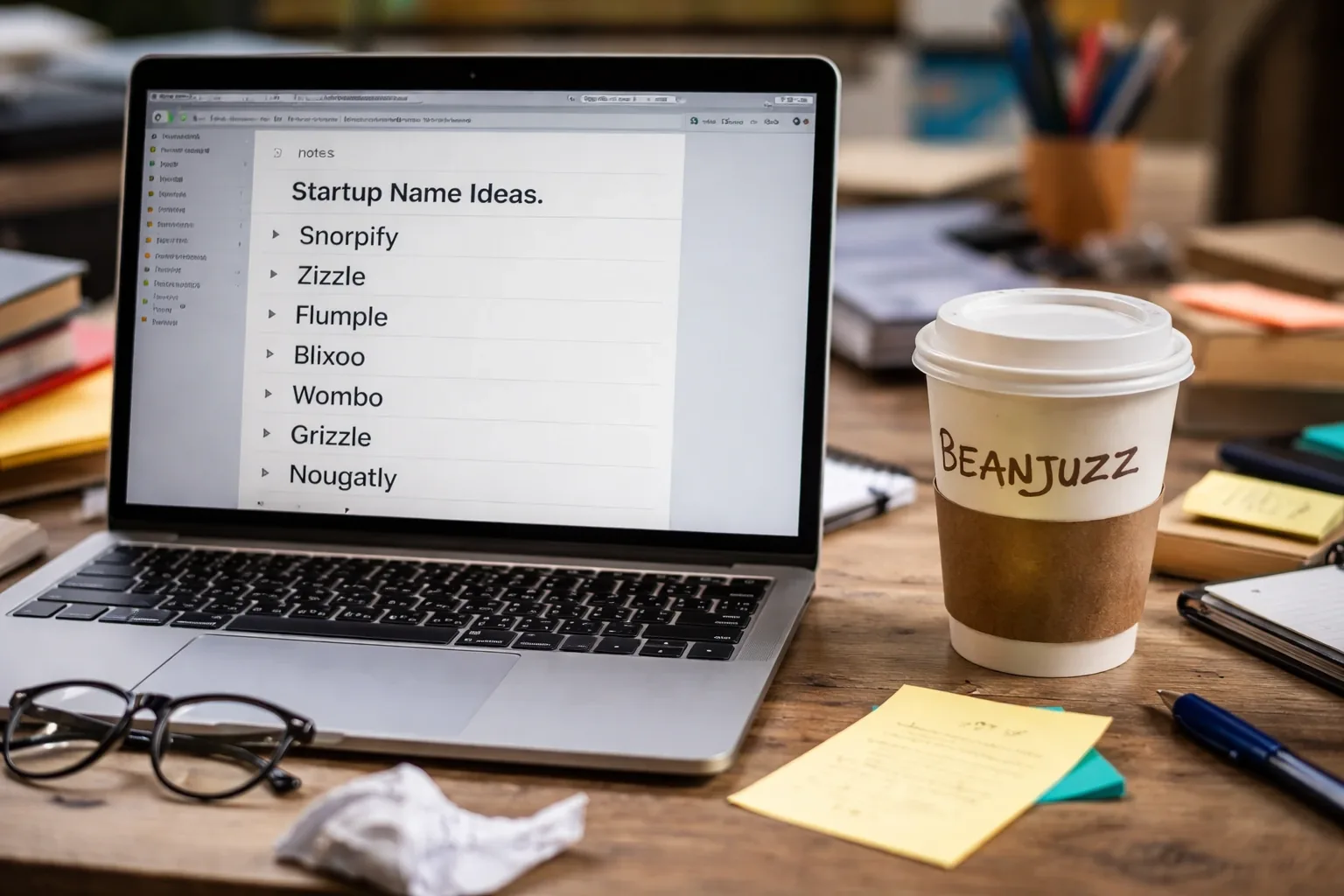
Why do many successful startup names sound strange at first?
Most successful startup names sound weird initially because they are intentionally unfamiliar, which helps them stand out and avoid preconceived meanings.
Unlike descriptive names, unfamiliar words create a blank slate that the brand can fill over time through product experience and marketing.
In practice, names that feel “off” trigger a moment of cognitive friction; that pause increases attention and recall in crowded markets, and repeated exposure turns weirdness into recognition and recognition into trust.
What makes a startup name “weird” in the first place?
A startup name sounds weird when it breaks normal language expectations such as spelling, pronunciation, or meaning.
This weirdness is rarely random; it often results from constraints like domain availability, trademark safety, and global usability.
- Invented words (blended syllables)
- Altered spellings
- Words borrowed from unrelated domains
- Short, abstract terms with no immediate meaning
In practice, a weird name works like an empty container: it has less baggage, so users associate it mainly with your product.
How unfamiliar names become memorable brands over time
Unfamiliar names become memorable through repetition and positive experience, not instant clarity.
This is why early confusion does not predict long-term brand weakness; it often signals distinctiveness.
Stats (verify before publishing): Distinctive brand assets can materially improve recall1 and non-descriptive names can outperform descriptive ones in memory after exposure;2 trademark approval dynamics may also favor distinctive terms.3 [SOURCE NEEDED for exact figures]
Definition blocks: weird, brandable, descriptive
Definition: Weird startup name
A weird startup name is a deliberately unfamiliar or non-descriptive name that lacks immediate semantic meaning but gains value through repeated brand association.
Definition: Brandable startup name
A brandable startup name is a short, distinctive, legally defensible name that can carry meaning over time rather than explain the product immediately.
Definition: Descriptive startup name
A descriptive startup name directly explains what a company does using common language, which can reduce flexibility as the product evolves.
Examples of famous startups with weird-sounding names
Many globally recognized companies started with names that sounded odd or confusing; the names worked because they became ownable through consistent association, not because they were instantly self-explanatory.
- Google: linked to “googol,” initially non-obvious.
- Spotify: invented word with no inherent meaning.
- Airbnb: compressed from a longer phrase, awkward at first.
- Slack: a common word recontextualized through product success.
Note: These are illustrative examples; cite primary sources for etymology and brand history if you include origin claims.
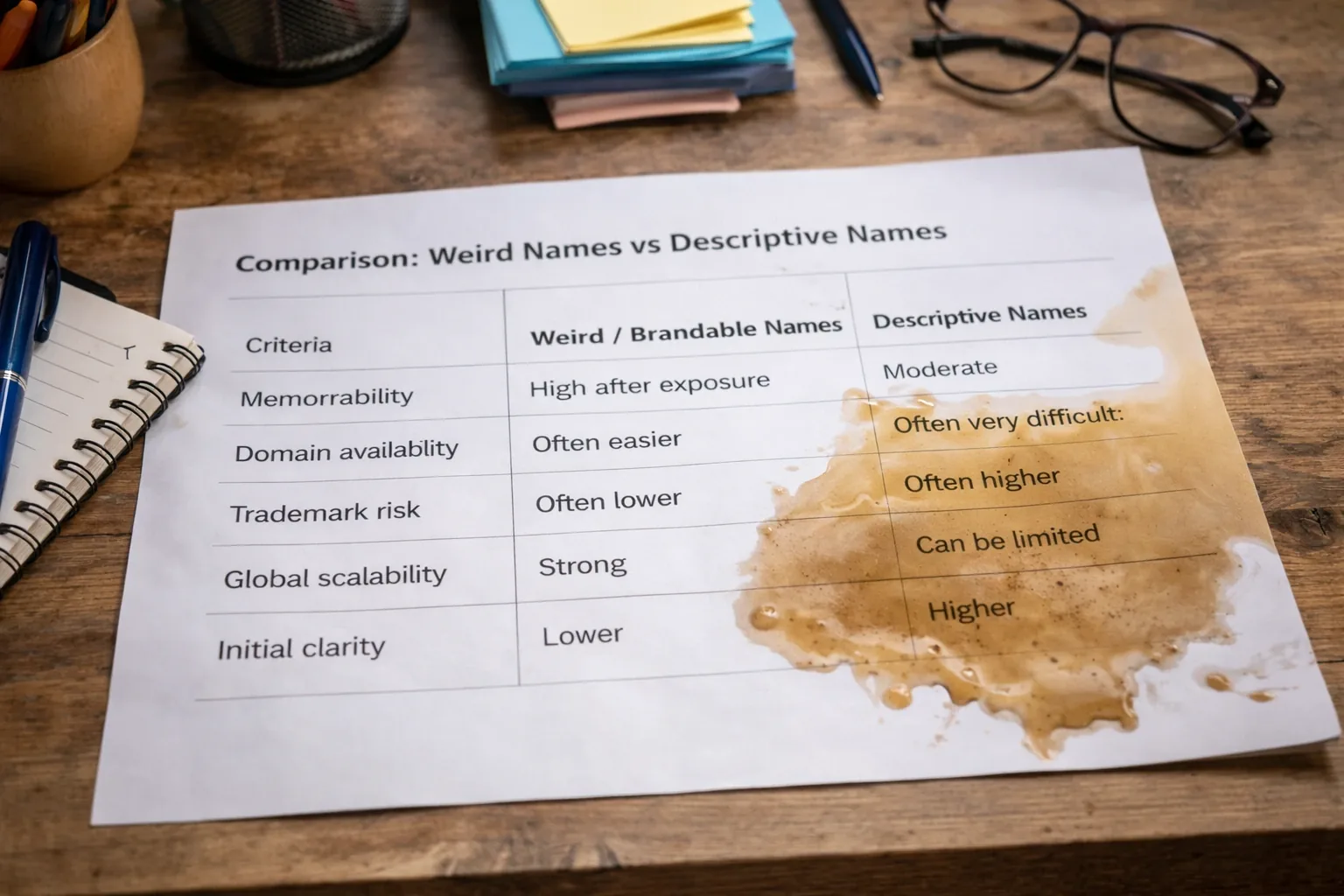
Comparison table: weird names vs descriptive names
Weird (brandable) names tend to win on differentiation and defensibility, while descriptive names tend to win on immediate clarity.
| Criteria | Weird / Brandable names | Descriptive names |
|---|---|---|
| Memorability | High after exposure | Moderate |
| Domain availability | Often easier | Often very difficult |
| Trademark risk | Often lower | Often higher |
| Global scalability | Strong | Can be limited |
| Initial clarity | Lower | Higher |
How founders should think about naming in practice
Founders should treat naming as a systems decision, not a purely creative exercise.
The goal is not maximum immediate explanation; it is long-term differentiation, legal safety, and domain ownership.
- Prefer distinctiveness over literal description
- Validate domain availability early
- Optimize for pronunciation and spelling under stress (podcast test, phone test)
- Consider future product expansion beyond today’s feature set
In practice, a weird-but-pronounceable name is like a clean username: it is easier to own, protect, and grow into.
Step-by-step: how to generate a strong startup name and domain
This process keeps creativity grounded in feasibility, so you do not fall in love with names you cannot own.
- Write a one-paragraph business brief (audience, problem, positioning, tone, and one competitor you are different from).
- Generate name directions (invented words, metaphors, category-adjacent terms, and short compounds).
- Check domain availability immediately to avoid dead ends and sunk time.
- Explore TLD options (e.g., .com, .io, .ai, niche, and country TLDs) based on audience and trust needs.
- Save finalists and organize them by vibe (serious, playful, premium, technical) and use case (product, company, platform).
- Pressure-test for pronunciation, typo risk, and search confusion before deciding.
Where Domain Generator fits (product-aligned)
Domain Generator (domaingenerator.co) is an AI-powered tool that helps founders, startups, marketers, and developers find the perfect domain name in minutes without switching between ChatGPT, registrars, and manual availability checks.
You describe your business once, and the platform instantly generates relevant domain ideas and verifies their availability in real time, including smart hints and alternatives, so you can iterate fast without tab-hopping.
Unlike traditional tools, Domain Generator checks availability as part of ideation, supports 500+ TLDs (including .com, .io, .ai, niche extensions, and country domains), and keeps searches private to reduce the risk of domain sniping; Domain Search and Domain Generator are free with unlimited searches, and logged-in users can save favorites, organize by projects, and export results when ready to buy.
Common mistakes founders make when naming startups
The most common naming errors come from optimizing for comfort instead of ownership.
- Falling in love too early before checking domain and trademark feasibility.
- Over-describing the product (“BestHRAnalyticsTool”) and boxing the company into a corner.
- Choosing unpronounceable weirdness that creates friction instead of intrigue.
- Ignoring international users (unexpected meanings, hard consonant clusters, or accent issues).
- Manual availability checking across registrars, which wastes time and encourages compromises.
Mini case study (template)
A SaaS startup in the HR analytics space needed a name that felt modern but not limiting; instead of keyword-stuffing “HR,” the team explored abstract, brandable options and filtered them by real-time availability.
Outcome (replace with your real numbers): naming time reduced by [X%], stakeholder alignment reached in [Y days], and early user recall improved by [Z%]. [SOURCE NEEDED]
The key shift was choosing an ownable name-direction first, then validating domains and constraints immediately.
FAQ
Why do weird startup names often outperform normal ones?
Weird names create distinct mental hooks and avoid generic associations, so once learned they stick like a nickname that refuses to leave the group chat.
Is it risky to choose a name people don’t understand at first?
Short-term confusion is common, but repeated exposure paired with a good product usually turns that confusion into recognition faster than founders expect.
Are descriptive startup names ever a good idea?
They can work for narrow local markets or short-lived campaigns, but they often reduce flexibility and increase trademark and domain friction as the business expands.
How weird is too weird for a startup name?
If people cannot pronounce it after hearing it twice, or cannot type it after seeing it once, it is likely friction not distinctiveness.
Do investors dislike weird startup names?
Most investors prioritize defensibility, memorability, and scalability; if the name is ownable and the story is clear, weirdness is rarely a deal-breaker.
Does a weird name hurt SEO?
SEO is driven by content, authority, and intent match; a unique name can even help by reducing SERP competition for branded queries.
Why is domain availability so important in naming?
A clean domain reduces confusion and trust leakage, and it prevents your launch traffic from accidentally visiting a different business that got the better URL.
Can AI really help with creative naming?
Yes, when AI understands context and positioning (not just keywords) it can surface options humans miss and validate feasibility faster than manual workflows.
Conclusion
Weird startup names often win because distinctiveness beats explanation over time, and because ownable domains and trademarks are easier to secure when the name is not generic.
- Distinctiveness compounds: unfamiliar names become memorable once associated with a good product and repeated exposure.
- Descriptive feels safe but narrows you: overly literal names can limit expansion and increase legal/domain friction.
- Availability is part of creativity: checking domains during ideation prevents wasted time and painful compromises.
- Pronounceable weirdness is the sweet spot: odd enough to stand out, simple enough to say and spell.
- Use tools that remove friction: Domain Generator helps you generate and validate brandable domains in real time across 500+ TLDs.
Next step: If you are naming a startup, start with a one-paragraph brief and run it through Domain Generator at domaingenerator.co to quickly shortlist distinctive, available options.
